
Wait, what is… Cherenkov radiation?
27th October 2025
3.5 minute read
"Nothing moves faster than the speed of light." That's the rule that everyone knows — light is the speed limit of the Universe. Yet, it's not quite true. Particles break this rule every day, and when they do they show us their prowess by leaving behind an eerie blue glow. A glow we call Cherenkov* radiation. So... wait, what is Cherenkov radiation?
Faster-than-light Particles
Before we get to the glow, we should probably address the elephant in the room — how can particles travel faster than the speed of light? Well... they don't. Not really.
The speed of light in a vacuum is the universal speed limit — roughly 300,000 km/s. But light doesn't always travel that fast. Yeah... sometimes physics is just annoying.
Quick Facts
- It is named after Pavel Cherenkov, a soviet physicist who first observed it in 1934.
- Cherenkov light only peaks in blue light, but actually it covers a large spectrum.
- Cherenkov light can appear in any transparent medium -- from water to biological tissue!
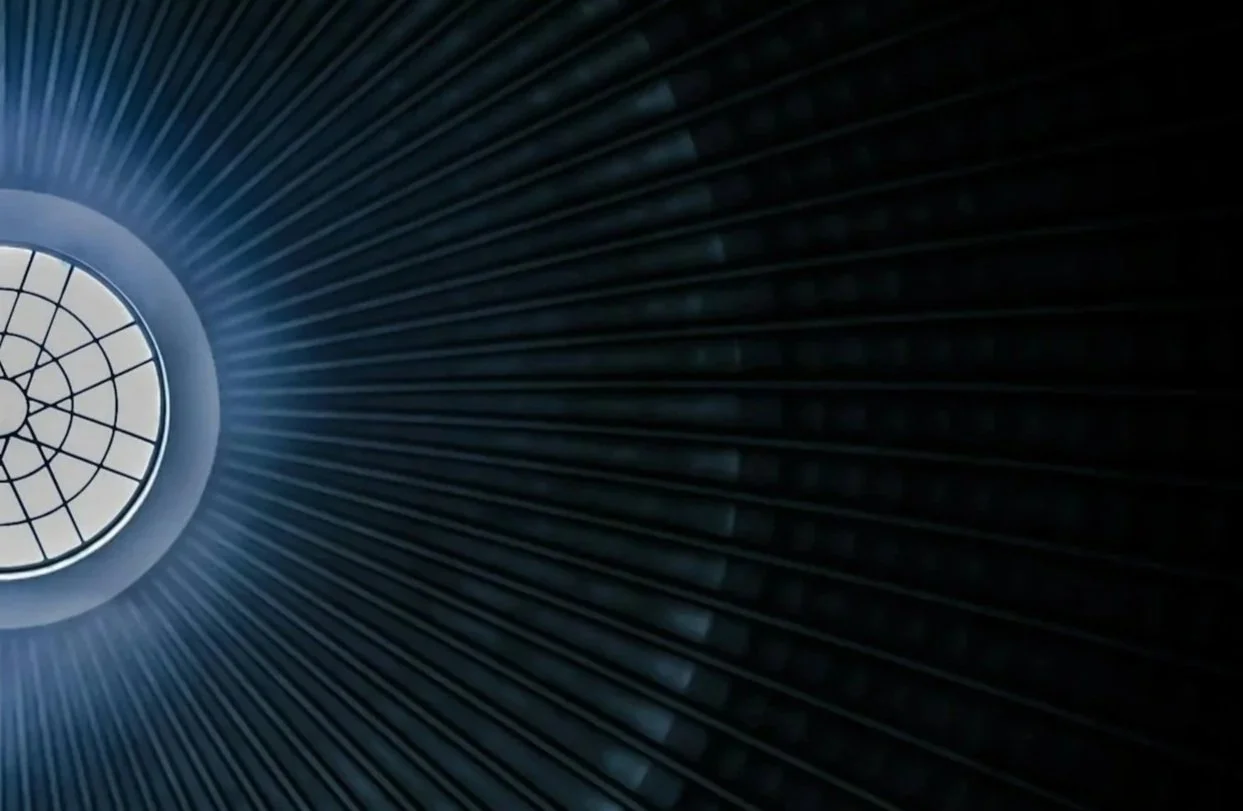
- In imaging detectors, the light forms a bright circular ring when projected onto a flat surface.
- The light is polarised (its electric field oscillates in one direction), just like what polarising sunglasses does to sunlight.
When light enters a transparent material, such as glass or water, light will bend in a process called refraction — like the straw bending at a strange angle in a glass of water. But why does it do this? Light — like myself — is inherently lazy. It will always choose the quickest route between two points, even if it has to slow down to do it. Physicists call this the principle of least time or, as I prefer it, the laziness principle.
And here's where things get interesting: light slows down just enough that particles can hit the gas, moving faster than the speed of light in that material. And that’s when the glow of a broken light barrier appears.
What is Cherenkov radiation?
So how does this light appear? Imagine you're dragging your hand through a swimming pool. As your hand moves, you push the water molecules aside — they get moved a little bit, then flow back into place once your hand passes.
In a material like water or glass, the molecules are made of atoms surrounded by "clouds" of electric charge — electrons. When a charged particle zips through that material, its electric field tugs on the atoms, pulling or pushing their electrons slightly out of place — just like your hand stirring the water.
Normally, those electrons have time to wobble and settle back down, releasing tiny flashes of light as they do**. But, because each one relaxes at a slightly different time, the flashes overlap and cancel out — what we call destructive interference. If, however, the particle is travelling faster than the speed of light can travel, these disturbances don't have time to die away randomly. They pile up and — just like your hand through water — reinforce one another and build one, coherent, wavefront: a cone of blue called Cherenkov radiation.
You can think of this as a sonic boom of light — the glowing signature of a speeding particle. Interesting to be sure, but why do we care about it?
Detecting the glow
Now that we have the glow... what do we do with it?
By analysing that light carefully, we can actually learn quite a bit. When a fast particle travels through a transparent material like water, glass or even plastic, it produces a cone of blue Cherenkov light that spreads out at a fixed angle.
The cone itself is very faint, and only lasts for a fraction of a second. But if we surround our material with light detectors, like photomultipliers, we can capture that light and work backwards to uncover information about the particle that caused it.
How? Turns out angles are the key! The exact opening angle of the cone depends on the speed of the particle — the faster the particle, the wider the cone***. From that we can determine how fast it was moving and, when combined with other measurements, we can work out the particle's mass and therefore its identity.
Of course, it's not always so simple. When the particles are very energetic — and therefore very fast — the angle of the cone barely changes. In these cases, detectors like Super-Kamiokande in Japan use other information. By studying the fuzziness (yep, that's the real term!) of the Cherenkov ring, physicists can tell whether that light came from an electron or a muon.
This eerie blue glow is more than beautiful — it's a luminous signature that the particle leaves behind.
Why does Cherenkov light matter?
Why do we care about this? Well, it allows us to see the invisible.
Particles such as neutrinos almost never interact with anything. Yet, when one does, it releases a particle capable of producing Cherenkov light. Detectors, like the previously mentioned Super-Kamiokande or IceCube, search for these flashes of light in order to study these elusive particles. These particles could be the key to how we're here, and we use these blue cones to study them.
We also use Cherenkov to see inside of nuclear reactors. Engineers use the glow to monitor reactor cores and confirm that fuel rods are active, confirming the reactor is functioning correctly. The medical industry has also been taking an interest in this special light, studying the light from radioactive tracers to trace the biomolecules inside the body.
So, whilst this light is faint, it can be useful in all reaches of life and science. From helping doctors heal the human body, to physicists studying where we all began, this ghostly luminescence appears all over the place.
Summary
So whilst nothing can truly outrun the speed of light in a vacuum, many can beat it in other substances. And when they do, they light the way for us to follow.
Cherenkov light allows us to see into the subatomic world -- it's how we see the unseen. It's the universe's way of showing us where the fastest things have been.
* Also written as Čerenkov, as it's named after Pavel Čerenkov.
** They release the energy gained as photons.
*** The equation for this is cos(θ) = 1/(nβ) where θ is the opening angle, n is the refractive index of the material and β is how fast the particle is going as a fraction of the speed of light.